Cloud and GPU Providers
Overview
Data center operators, regional and sovereign clouds, and GPU clouds sell compute to many customers. Waldur is the part their customers deal with: a catalog with price plans, ordering, organizations and projects, metering and monthly invoices. Underneath, the provider keeps the platforms it already runs, such as OpenStack, VMware, OpenNebula, Kubernetes or Slurm.
- A catalog with price plans: fixed monthly, usage-based, one-time and prepaid terms, chosen per plan, with discounts and credits.
- GPU capacity metered by type: GPU-hours on Slurm, GPU and vGPU allocations on OpenStack, GPU quotas on Kubernetes, each with its own price.
- LLM access sold by the token: an API key per customer on a LiteLLM or Envoy AI Gateway proxy, with budgets, rate limits and token usage metered for billing.
- Organizations, projects and roles for every customer, with orders approved by the customer, the project or the provider.
- Monthly invoices in PDF, CSV or XLSX, with optional EU VAT, or usage taken into an existing billing system through the API.
- Self-service and automation: the portal, a REST API, SDKs for Python, TypeScript and Go, a Terraform provider and an Ansible collection.
- One support line through the built-in service desk, or Jira Service Management, Zammad or OpenText SMAX.
In the portal
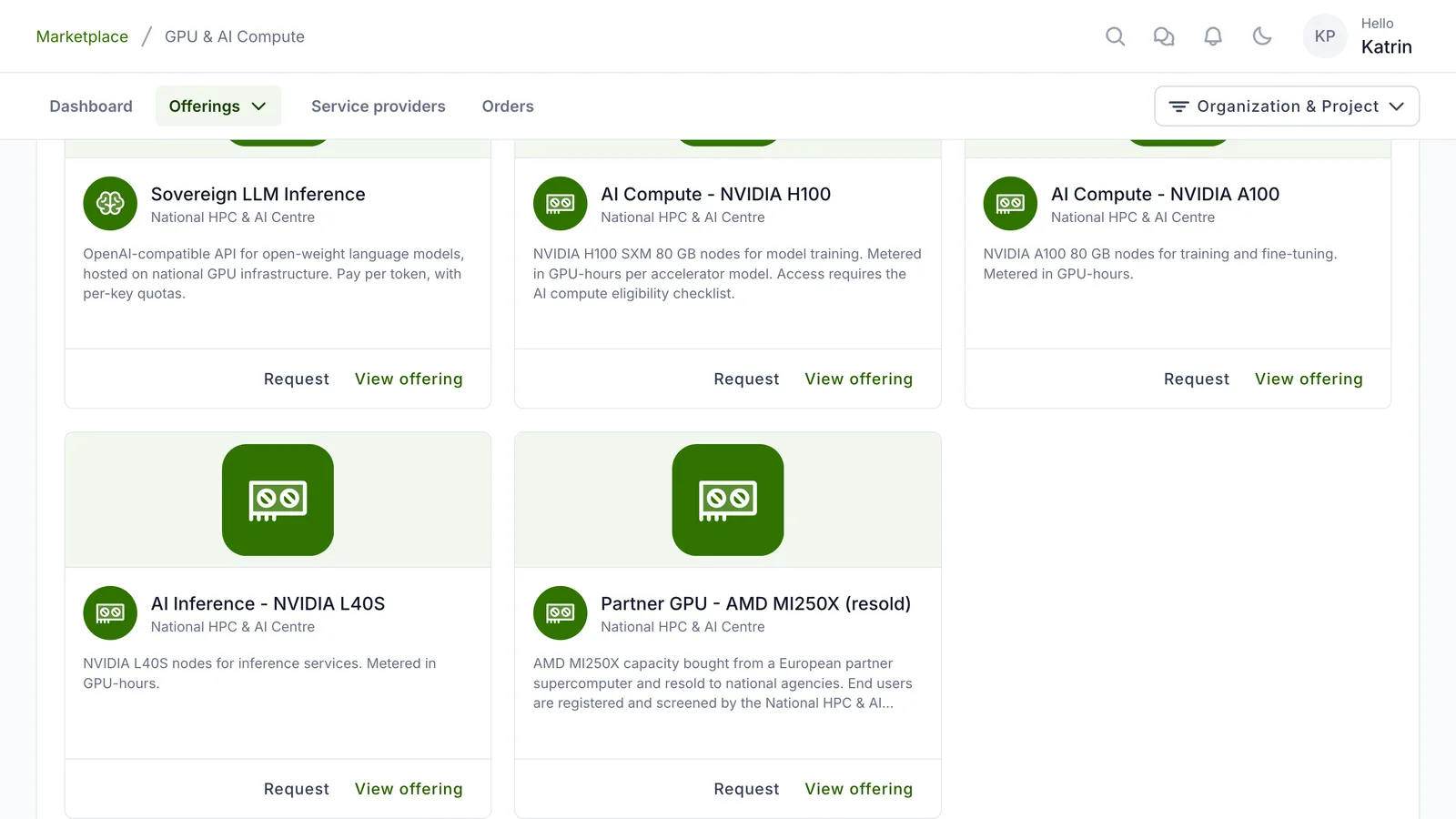
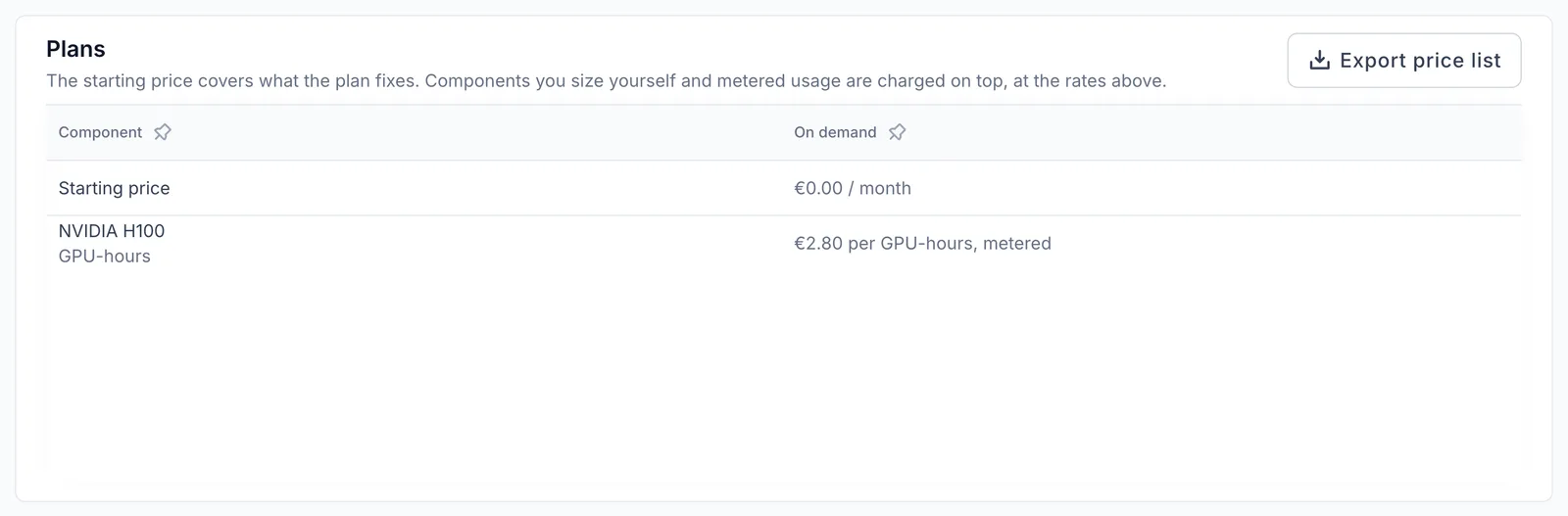
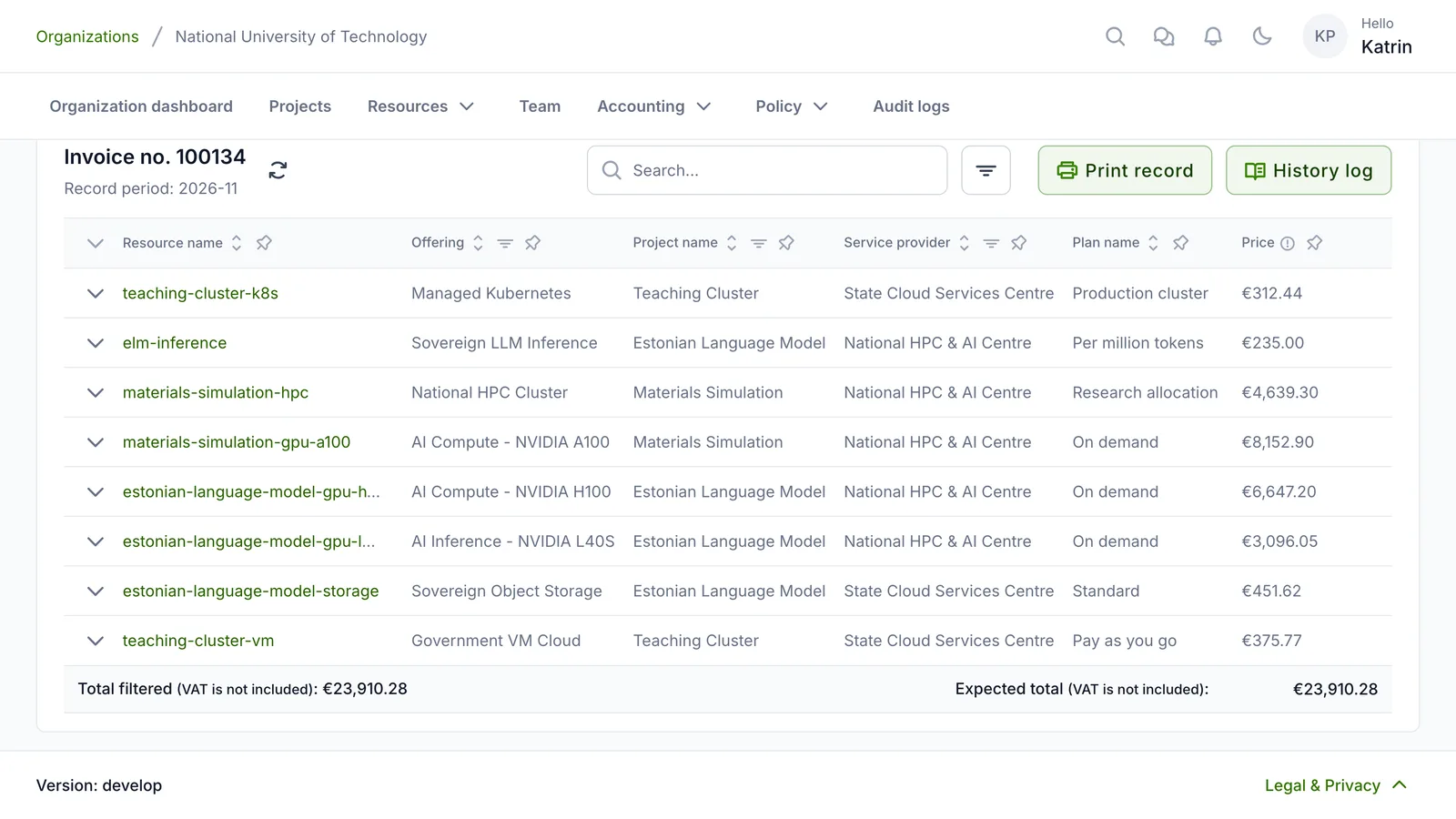
Recorded on a demo deployment: the organizations, people and numbers are made up.
How Waldur fits
- OpenStack and VMware vCenter: tenants, virtual machines, volumes and networks.
- OpenNebula, Kubernetes, OKD and Rancher: virtual machines, namespaces and projects with quotas.
- Slurm: accounts with CPU- and GPU-hour limits, and usage per project.
- Storage and registries: Ceph S3 object storage and Harbor, through the Waldur Site Agent.
- Any other service as an offering fulfilled by the provider's staff, or automated with custom scripts.
What stays with other systems
- Scheduling and partitioning GPUs, such as MIG, vGPU or fractional GPUs, is done by the platform underneath. Waldur meters and bills the result.
- Bare-metal provisioning and colocation (racks, power, connectivity) are not automated. They can be sold as offerings fulfilled by the provider’s staff.
- Waldur issues invoices but takes no card payments, and one deployment uses one currency.
Further reading
- Billing and accounting Price plans, billing types, invoices and VAT
- OpenStack Tenants, instances and billing from OpenStack
- Waldur Site Agent Connecting clusters and services at the provider's site
- LiteLLM API keys, budgets and token usage for LLM inference
- Deployment with Helm Installing Waldur on Kubernetes
Implementation
Project phases
Proof of concept
Deploy Waldur and connect one platform, such as an OpenStack region or a GPU cluster. Define the first offerings and price plans.
Billing
Decide how usage is invoiced, with Waldur's monthly invoices or through the existing billing system, and test it with a month of real usage.
Customer sign-in
Connect the identity providers customers use, through Keycloak, OpenID Connect, SAML or LDAP, and set up organization onboarding.
Production launch
Open the portal to customers. Set up monitoring, backups and the support channel.
More services
Add GPU, Kubernetes, storage or LLM offerings, and managed services fulfilled by staff.